Modular Construction vs Stick-Built Refinery Erection
Every EPC contractor with a quarterly target and a PowerPoint deck loves the word “modular.” It is the industry shorthand for done-faster, done-cheaper, done-safer — usually pitched with graphs that slope aggressively down and to the right.
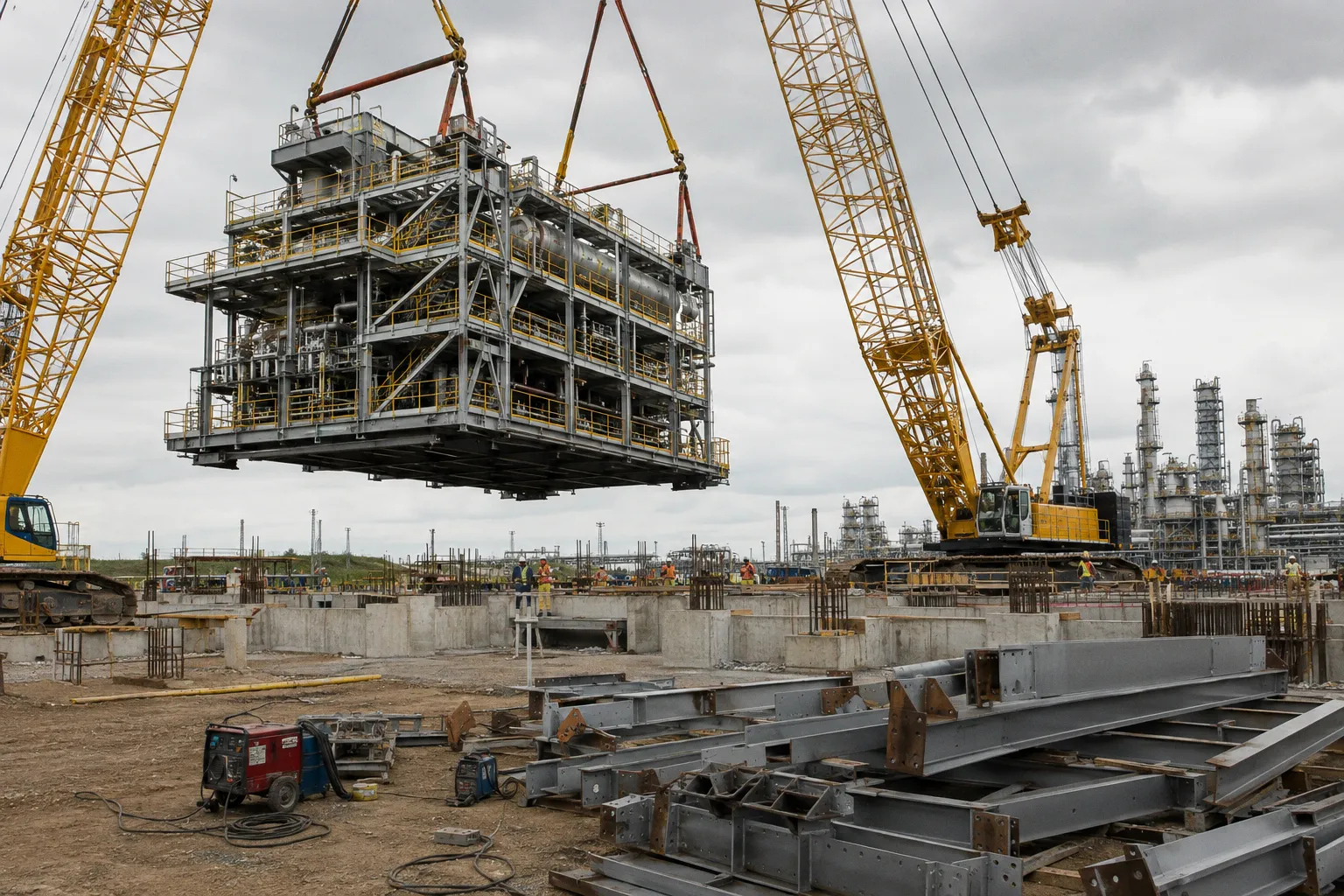
Stick-built, by contrast, gets treated like a relic: the slow, sweaty, sequential option that survives mostly because mega-projects are still too large, too heavy, or too awkward to move as complete units.
Both framings miss the point. The real question in modular construction vs stick built refinery erection is not which method is universally better. It is which method fits the specific refinery you are trying to deliver, on the site you have been given, with the labor market, transport network, lifting capacity, weather window, and process layout you actually have.
Modularization can remove a large amount of fabrication from the field. It can also move complexity into transport engineering, temporary works, lifting studies, route approvals, and interface management. Stick-built construction accepts more site work, but it avoids the requirement to make an entire process block behave like cargo before it becomes part of the plant. The comparison only becomes useful when both sides of that trade are visible.
Parallel Workflows: The Mechanics of Modular Fabrication vs Sequential Erection
The structural difference between the two approaches is not philosophical. It is logistical.
Stick-built refinery construction executes the work the way it sounds: piece by piece, in sequence, on-site. Steel goes up first, then equipment gets rigged onto it, then piping and instrumentation follow in a carefully choreographed dependency chain. Civil preparation has to reach the required stage before structural erection can begin. Structural erection has to advance before major equipment lifts can be completed. Equipment installation has to progress before piping crews can close tie-ins. Electrical, instrumentation, insulation, testing, and commissioning then inherit the condition of everything that came before them.
That does not mean stick-built projects are literally linear. Good construction planning overlaps trades wherever access and safety allow it. But the overlap is constrained by the physical state of the site. A pipefitter cannot close a line that is not supported. A cable crew cannot finish an area that is still being modified by structural or mechanical teams. A crane cannot serve two work fronts at once simply because the schedule says both activities are urgent.
Modular construction rearranges that dependency chain by doing as much work as possible off-site, in a controlled fabrication yard, while site civil work runs in parallel. Process equipment — reactors, columns, heat exchangers, pump skids, packaged units, pipe racks, and utility assemblies — can be assembled onto structural skids before they arrive at the refinery site. Piping spools, supports, platforms, cable trays, valves, and access systems may be installed in the yard as part of the same package, depending on the module’s design and transport envelope.
By the time foundations, anchor bolts, underground services, and access routes are ready on-site, the modules may be approaching shipment or set-down. The site then becomes primarily a receiving, lifting, connecting, testing, and commissioning operation rather than the location where every part of the process block is fabricated from loose components.
That is the source of modularization’s schedule advantage. The yard and the site are no longer competing for the same crews, the same crane windows, or the same weather conditions. They can develop in parallel. The benefit is not that every individual weld or bolt is completed faster. The benefit is that more of the total work can proceed at the same time.
This distinction matters when reviewing schedule claims. A stated reduction in the overall construction period may reflect genuine parallel work, but it may also depend on early design release, procurement of long-lead equipment, foundation readiness, transport permits, and a receiving site that is prepared to accept the modules. Modular fabrication does not remove dependencies. It changes their location and, in some cases, makes them less visible until late in the project.
What is actually moved off-site?
The word “module” covers several different arrangements. A small pump or compressor skid is not subject to the same design problem as a multi-level process module with equipment, piping, platforms, and electrical systems already installed.
The off-site scope may include:
- Equipment mounted on a common structural skid, with only final connections completed in the field.
- Pipe racks or utility corridors fabricated in transportable sections.
- Packaged process units supplied by a specialist vendor.
- Pre-assembled structural frames with equipment installed later on-site.
- Large assemblies delivered in several lifts rather than as one complete module.
- Hybrid packages in which the most congested work is completed in the yard, while bulky or fragile items remain field-installed.
The more work is integrated into the module, the greater the potential reduction in field activity. The more integrated the module becomes, the more demanding its transport, lifting, temporary support, and interface design also become. There is no free movement from “field-built” to “fully modular.” The project is choosing where to carry the complexity.
Structural Integrity and the Logistics of Transporting Heavy Process Skids
The catch nobody puts on the front slide is that modules do not simply roll out of the shop on a flatbed. A transportable process module is a temporary structure, a lifting object, and eventually a permanent operating structure. Those three conditions have to be reconciled in one design.
Transport frames add structural steel mass to the skid. The module has to withstand acceleration, braking, vibration, torsion, support reactions, and possible uneven loading during movement. If it is transferred between road, barge, rail, or heavy-haul equipment, each stage can impose a different support arrangement. Lifting introduces another load case: the module may be supported at lifting points that do not coincide with its operating supports or transport stools.
The design therefore has to account for more than normal operating loads. Engineers may need to assess:
- The location and stiffness of lifting lugs or trunnions.
- Temporary transport stools and support points.
- Local reinforcement around equipment saddles and pipe supports.
- Deflection limits for sensitive equipment and connected piping.
- Center of gravity and center-of-lift alignment.
- Differential movement between the module frame and installed equipment.
- Restraint details for loose, removable, or vibration-sensitive components.
- Tie-down forces and the sequence of load transfer between transport systems.
- Final jacking, skidding, SPMT, crane, or strand-jacking arrangements where applicable.
That extra steel is not free, and it is not optional if the module is expected to survive the journey without distortion. It is the price of admission for the parallel-workflow benefit.
This is where the “modular is cheaper” narrative gets slippery. The material cost of the transport frame and the reinforcement around it can exceed what a comparable stick-built assembly would require, because the design loads are dictated by logistics rather than operating conditions. The savings show up later — in reduced field labor, fewer weather-exposed activities, shorter site duration, and potentially lower temporary facilities costs. They do not show up on the steel purchase order.
Anyone reading a modular EPC proposal that does not separate operating steel from transport and lifting steel is reading an incomplete cost estimate. The same applies to temporary works. A modular comparison should make visible the cost of grillage, saddles, sea fastening, route preparation, lifting studies, escorts, permits, staging areas, and final alignment. Those items may be decisive even when the module itself is technically transportable.
Modular construction is not a steel-cost story. It is a labor-and-schedule story with a steel surcharge attached.
The second logistics constraint is dimensional. A skid that fits on a standard highway trailer is one problem. A process module that exceeds ordinary road clearances, has a high center of gravity, or weighs several hundred tonnes is another. The answer cannot be inferred from refinery capacity alone.
Transportability depends on the actual module and the actual route. Relevant variables include:
- Overall length, width, height, and weight after all temporary supports are installed.
- The route’s bridge capacity, turning radii, overhead clearances, gradients, and pavement condition.
- Availability of suitable ports, barges, heavy-haul vehicles, rail corridors, or roll-on/roll-off facilities.
- Seasonal restrictions, traffic management, border procedures, and local permitting.
- The condition of the receiving site, including laydown space and final access to the foundation.
- Tidal, river, or weather constraints where water transport is part of the plan.
- The ability to position and lift the module without rebuilding the site around the operation.
A module may be transportable in principle but uneconomic on the selected route. It may also be transportable to the site but impossible to install without temporary road strengthening, bridge reinforcement, shoreline work, or a more complicated lifting sequence. That is why the feasibility study has to start with a route and lifting concept, not with a preferred construction label.
The distance from fabrication yard to site remains one of the most underweighted variables in early modular studies. A nearby yard with suitable fabrication capacity may support a large module. A distant yard may make a smaller module unattractive once handling, permits, sea fastening, multiple transfers, and schedule risk are included. The boundary between “modular” and “stick-built” is therefore not a fixed weight or capacity threshold. It is a project-specific logistics boundary.
Quantifying the 50% Reduction in On-Site Labor and Safety Risks
The headline number for modular is the on-site labor reduction, often cited as up to 50% compared with traditional stick-built methods. That figure can be meaningful, but it is not a universal allowance and should not be inserted into a business case without defining the scope behind it.
What drops is not all labor. It is primarily field labor: the welders, fitters, ironworkers, electricians, riggers, scaffolders, and supervisors who would otherwise be tying steel, setting equipment, installing supports, running piping, and completing connections on-site under weather, at height, and in a congested laydown area.
What does not automatically drop — and can sometimes increase — is skilled commissioning labor, engineering support, inspection, documentation, preservation, transport coordination, lifting supervision, and interface management. A modular project also requires a fabrication-yard organization capable of producing repeatable, traceable work without creating a backlog of defects that follows the modules to site.
The 50% figure also assumes that the modular scope is genuine modular scope. A half-hearted skid-and-ship arrangement, in which most piping, cable, insulation, access steel, and testing still happen at the refinery, will not produce the same field reduction as a highly integrated module. The percentage should therefore be treated as an outcome of scope definition, not as a property of the word “modular.”
A more useful labor comparison separates the work into four questions:
1. How many direct field hours disappear?
This includes work that is genuinely completed in the yard rather than merely prefabricated and then extensively reworked on-site.
2. How many yard hours are added?
The total labor requirement may move rather than vanish. The economic value comes from where that labor is performed, how reliably it can be scheduled, and what site overhead it avoids.
3. What supervision and support remain necessary at the refinery?
Fewer installation crews do not mean an empty site. Heavy lifts, alignment, tie-ins, testing, preservation, and commissioning still require experienced personnel.
4. Which activities remain on the critical path?
If underground services, utilities, long-lead equipment, permitting, or commissioning govern the completion date, a reduction in field labor may not translate directly into the same reduction in total project duration.
The safety argument is stronger when it is stated precisely. Modularization can shift a substantial share of fabrication from an active construction site to a yard environment with more controlled access, level working surfaces, established lifting zones, and repeatable workstations. That can reduce exposure to work at height, congestion, simultaneous operations, and weather-sensitive hot work.
It does not eliminate risk. The risk profile changes. The yard takes on heavier assembly operations, concentrated lifting, transport handling, and potentially higher consequence events if a large module is damaged or unstable. The site still faces major lifts, temporary works, tie-ins, energization, hydrotesting, and commissioning. Safety gains therefore depend on how the module is designed, handled, inspected, and installed, not simply on whether it was fabricated away from the refinery.
| Parameter | Stick-Built Erection | Modular Construction |
|---|---|---|
| Workflow structure | Primarily site-based, with dependencies between trades | Yard fabrication and site preparation proceed in parallel |
| Field installation scope | Steel, equipment, piping, supports, access, and services installed progressively | A larger share of these systems may arrive pre-assembled, depending on module definition |
| On-site labor | Higher direct installation requirement | Potentially lower, with labor transferred to the fabrication yard |
| Structural steel | No dedicated transport frame for the complete assembly | Additional transport, lifting, and temporary-support steel may be required |
| Weather exposure | More field work remains exposed to site conditions | Some fabrication occurs in controlled or sheltered conditions |
| Site congestion | Trades and heavy equipment share the same work fronts for longer | More concentrated receiving, lifting, connection, and commissioning period |
| Logistics burden | Lower for individual components, though many deliveries are required | Higher for oversized or heavy modules; depends on route and handling method |
| Design flexibility | Easier to adapt work packages in the field | Late changes can affect module weight, center of gravity, interfaces, and transport |
| Main schedule risk | Access, labor productivity, weather, and sequential handoffs | Design maturity, fabrication release, transport, lifting, and interface readiness |
Economic Drivers for the 10,000–30,000 BPD Modular Refinery Segment
The 10,000–30,000 BPD range is often discussed as a promising segment for modular refinery development because it can sit between a small packaged installation and a fully integrated mega-project. The economic logic is straightforward: the facility may need to be delivered quickly enough to fit a financing or supply window, yet may not have the scale to absorb a long, heavily site-based construction program.
That does not make every refinery in this band automatically modular. Capacity is only one input to the decision. The process configuration, plot arrangement, product slate, utility integration, location, and available route can matter more than the nominal barrel-per-day figure.
Where the case is favorable, modularization compresses the period during which the owner is paying for a large field organization without yet producing revenue. It can also reduce the amount of temporary accommodation, site logistics, scaffolding, laydown management, and weather contingency required at the greenfield location. Those savings are particularly relevant when the site is remote or when local construction capacity is thin.
The transport question needs more discipline than the usual capacity-based sales pitch. A refinery rated below a particular throughput is not automatically made up of modules that can travel by ordinary road or short-sea route. Module size is determined by the process design and the chosen split between yard and site. One 10,000 BPD project may be divided into relatively manageable skids; another may concentrate equipment into larger, heavier assemblies. The route, not the capacity label, decides whether the proposed configuration is practical.
The same applies to lifting. A project may use conventional cranes for some modules, while another may require specialized lifting, skidding, jacking, or transfer systems because of module mass, reach, ground conditions, or the absence of suitable crane capacity at the site. Heavy-lift ships, hydraulic strand jacks, large crawler cranes, SPMTs, and other systems are not default requirements for a capacity band. They are project-dependent options that enter the design when the module and the site demand them.
This is why a serious modularization study should test several module-breakdown scenarios rather than compare one modular concept with one stick-built concept. The study should ask:
- What is the smallest practical number of modules?
- What is the largest module the route can accept without disproportionate enabling work?
- Which equipment should remain separate because of weight, fragility, or maintenance access?
- Does splitting a module reduce transport risk while creating too many field connections?
- Can the site receive the modules in the planned sequence?
- What happens if one module is delayed, damaged, or rejected at inspection?
- Does the proposed module boundary support commissioning, or does it create a dense cluster of difficult final tie-ins?
Labor markets are another important driver. In regions where field welders, pipefitters, ironworkers, or commissioning technicians are scarce, moving a portion of the work into a fabrication yard can make the project easier to staff. A yard may offer more predictable access, accommodation, supervision, tooling, and quality control than a remote greenfield site. It can also support repeatable production when several similar modules are being fabricated.
But the labor advantage is not automatic. A distant fabrication yard may require its own recruitment campaign, accommodation program, specialist subcontractors, and quality organization. If local site labor is inexpensive and readily available, the wage and transport premium of the yard can erase much of the benefit. The economic comparison has to include total installed cost, not just the field labor line.
The cost moves before it falls
Modularization tends to move expenditure earlier in the project. Design must mature sooner. Equipment interfaces must be frozen earlier. Structural analysis, lifting studies, transport surveys, and preservation procedures cannot be postponed until the modules are already under fabrication.
That front-loading can be a financial advantage when it protects the construction schedule. It can also become a liability if the owner is still changing the process configuration while the yard is preparing to fabricate. A late change to a nozzle orientation or piping route may be a manageable field adjustment in a stick-built project. In a finished module, it can require engineering rework, cutting and rewelding, repeat inspection, retesting, or a change to the transport condition.
The economic choice is therefore shaped by the owner’s ability to make decisions early. Modularization rewards design maturity. Stick-built construction is not immune to late changes, but the consequences of those changes are often distributed across field work packages rather than concentrated in a single transportable assembly.
Strategic Limitations: When Stick-Built Methods Remain Essential for Mega-Projects
The honest version of this comparison ends where the hype version skips: modular is not, and will not be, the right answer for every refinery. Several constraints keep stick-built methods firmly in the toolkit.
Dimensional and route limits
Some process units are too large, too heavy, too tall, or too structurally delicate to transport economically as complete assemblies. Multi-level structures, large reactors, integrated regeneration systems, sulfur recovery blocks, tall columns, and heavily interconnected units can exceed the practical envelope of the available road, port, waterway, or lifting infrastructure.
“Technically movable” is not the same as “sensible to move.” A module can pass a route study and still require so much bridge work, road strengthening, traffic control, temporary marine infrastructure, or specialized handling that the field alternative becomes more attractive. In other cases, the unit can be moved but cannot be positioned safely within the available site footprint.
When the practical module boundary becomes too small, the promised benefit also shrinks. If a supposedly modular process block arrives as many separate pieces requiring extensive field assembly, the project may retain the logistics burden without receiving the full labor and schedule benefit.
High customization and low repetition
Modular construction rewards repetition. If a refinery is based on a proven arrangement, uses repeatable packaged units, and has stable equipment interfaces, the yard can apply lessons from one assembly to the next. Design-for-modularization becomes a system rather than a one-off exercise.
A highly customized refinery is different. Novel process integration, unusual heat-recovery arrangements, constrained plot plans, nonstandard utility systems, and owner-specific equipment can make every module unique. Each unique module is effectively a custom fabrication package. The yard may still offer quality or schedule advantages, but the production-line economics become less convincing.
The same problem appears when the project team treats modularization as a late procurement decision. Modules work best when plot layout, structural design, equipment selection, piping philosophy, lifting strategy, and commissioning boundaries are developed together. Choosing modules after the plant has already been designed as a conventional field erection project usually produces awkward interfaces and avoidable transport compromises.
The wrong critical path
A modular project can shorten field erection and still fail to shorten the overall project. Large refineries are governed by more than steel and piping. Permitting, financing, long-lead proprietary equipment, utilities, product storage, power supply, feedstock arrangements, off-taker commitments, and commissioning readiness may control the completion date.
In that situation, a shorter module installation window is valuable but not decisive. The saved field time may create float rather than earlier production. That can still reduce congestion and execution risk, but it should not be sold as a guaranteed revenue acceleration.
The same logic applies to smaller projects. If the foundations, access road, power connection, or storage facilities will not be ready when the modules arrive, early fabrication simply creates an expensive preservation and storage problem.
Transport infrastructure and geography
Mountainous terrain, weak bridges, restricted waterways, poor port access, difficult border crossings, seasonal roads, or politically complex transport corridors can change the economics completely. A fabrication yard that looks close on a map may be functionally remote once the heavy-haul route is analyzed.
There is also a sequencing risk. The project may depend on one narrow transport window, one barge, one heavy-lift contractor, or one route through a populated area. If that operation slips, several completed modules may be waiting in storage while the site crew remains idle. Stick-built construction spreads deliveries across a longer period and may offer more ways to work around a delayed component.
| Stick-built remains attractive when… | Why modularization may lose its advantage |
|---|---|
| Process units exceed the practical transport envelope | Complete assemblies cannot reach the site or require disproportionate enabling work |
| The refinery is highly customized | Yard repetition and standardized interfaces do not materialize |
| The main bottleneck is permitting, utilities, or long-lead equipment | Faster module installation does not move the overall completion date |
| The route has weak bridges, restricted waterways, or difficult access | Transport, permits, temporary works, and handling risk consume the labor savings |
| The site has a deep, affordable construction labor pool | The yard, transport, and management premium may outweigh field savings |
| The design is still changing late in the project | Module rework can be more disruptive than field adaptation |
| The receiving site cannot accept modules in sequence | Completed units require storage, preservation, or repeated handling |
| Commissioning boundaries are poorly defined | Pre-assembly creates more complex final tie-ins rather than a clean handover |
Making the Modularization Decision at the Right Level
The strongest project teams do not ask whether the refinery should be “modular” or “stick-built” as if the answer must apply to every discipline. They decide at the system and package level.
A refinery may use modular skids for pumps, compressors, chemical injection, water treatment, or utility packages while erecting large process structures in the field. Pipe racks may be fabricated in sections, with equipment installed on-site. A unit may be divided into transportable assemblies, with the heaviest vessels delivered separately. Electrical rooms and control buildings may be shipped as enclosed packages even when the surrounding process area is stick-built.
This hybrid approach is often more realistic than either extreme. It preserves modularization where the yard can add value and retains field erection where transport or customization makes pre-assembly unattractive.
The decision should be based on the full chain from fabrication to commissioning:
1. Define the module boundary.
State exactly what is included: structural steel, equipment, piping, valves, cable trays, electrical systems, insulation, platforms, and testing scope.
2. Check the transport condition, not the operating condition.
Analyze the module as it will actually travel, including temporary supports, restraints, lifting points, protection, and sea fastening where relevant.
3. Develop the route and receiving plan early.
A route survey should identify physical constraints, permitting requirements, staging areas, and the final path from transport equipment to foundation.
4. Test several lifting concepts.
The appropriate system depends on module mass, geometry, reach, ground bearing capacity, access, available equipment, and the required setting sequence. It should not be assumed from a generic refinery capacity range.
5. Map the field interfaces.
Count not only the number of modules but also the number and difficulty of final welds, bolted connections, cable terminations, instrument hookups, hydrotests, flushing activities, and commissioning boundaries.
6. Compare total installed cost.
Include yard fabrication, transport frames, permits, escorts, route improvements, lifting or jacking systems, storage, preservation, field labor, temporary facilities, engineering, inspection, and contingency.
7. Stress-test late changes and delays.
Ask what happens if equipment arrives late, the route is unavailable, a module fails inspection, or the foundation is not ready. The most elegant modular schedule is fragile if it has no recovery path.
This is also where industrial steel structure engineering becomes more than a fabrication question. The frame has to be designed for operating loads, transport loads, lifting loads, installation tolerances, thermal movement, vibration, corrosion protection, access, maintenance, and future replacement. A transport frame that works perfectly as temporary steel may interfere with drainage, fireproofing, inspection access, or equipment removal once the plant is operating.
The Practical Verdict
If you are evaluating modular construction vs stick built refinery erection for a project in the 10,000–30,000 BPD range, in a region where field labor is scarce or expensive, with a fabrication yard that has suitable capacity and a route that can accept the proposed modules, modularization may win on schedule, safety exposure, and total installed cost.
The important word is may. The result depends on the actual module breakdown, transport route, lifting method, site readiness, and amount of work genuinely removed from the field. A capacity range can identify a candidate segment; it cannot replace a route study or a project-specific lifting analysis.
If you are building a multi-hundred-thousand-barrel integrated complex with custom process units, restrictive geography, and a schedule driven by factors modularization cannot compress, stick-built is not legacy thinking. It is the correct engineering answer for the constraints on the ground. The same may be true for any project where the modules become too large to move efficiently, too fragmented to deliver a real field benefit, or too sensitive to late design changes.
The mistake is treating these methods as competing ideologies. They are tools. Modular fabrication moves work into a controlled environment and creates parallel activity, but it adds transport, structural, lifting, and interface obligations. Stick-built erection keeps more work at the refinery, but it preserves flexibility and avoids turning the plant into cargo before it becomes a plant.
The job is not to choose the method that looks best in a presentation. It is to choose the construction sequence that survives contact with the route, the foundations, the crane plan, the labor market, and the commissioning schedule.