Is Weathering Steel Worth It for Industrial Structures?
Every five to seven years, the maintenance crews arrive at a refinery or large chemical complex with sanders, blast equipment, and dozens of tons of industrial coatings — and the cycle begins again.
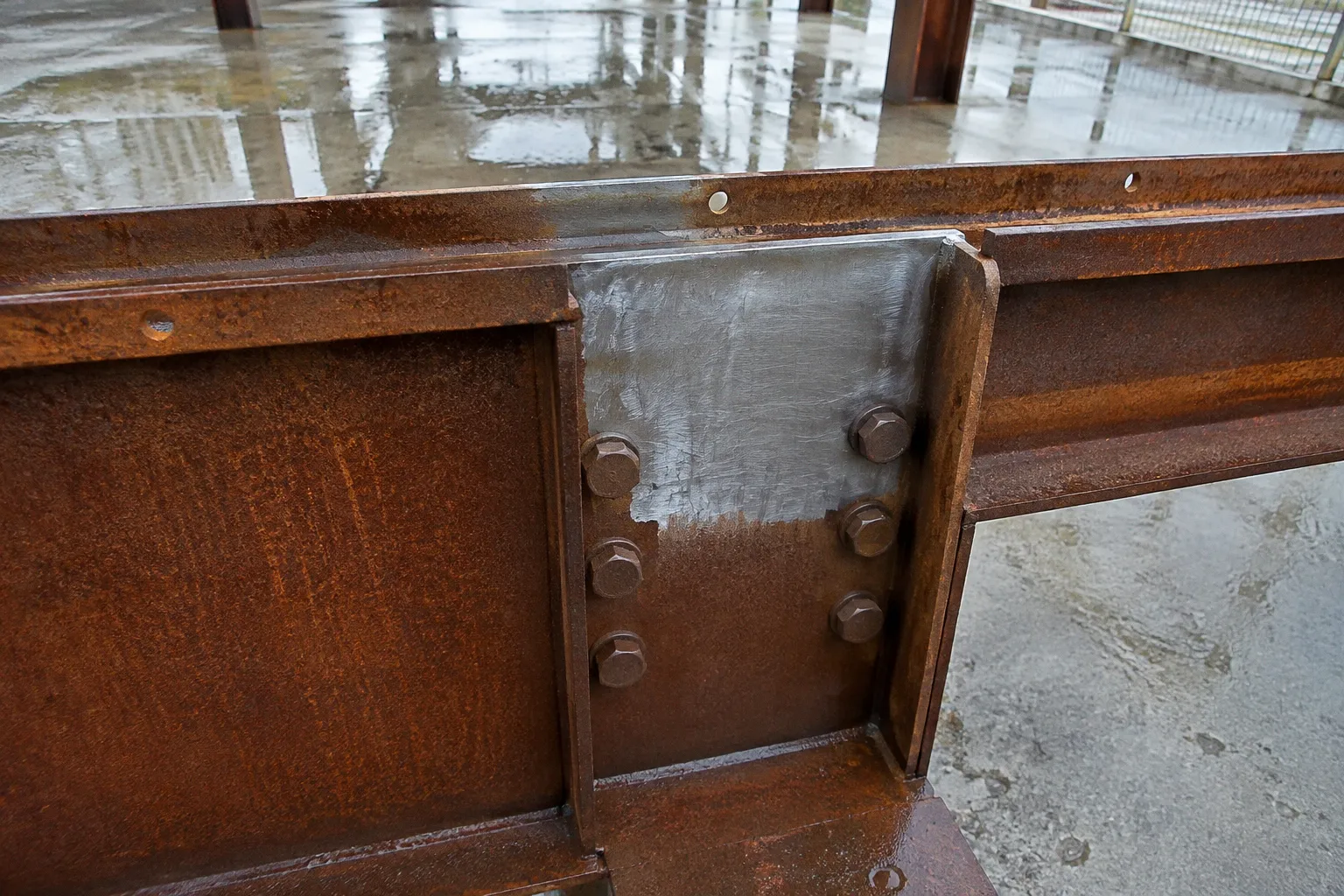
Pipe racks, exposed walkways, support frames, equipment platforms: all the steel that lives above the process units but breathes the same fouled atmosphere. For owners tired of watching paint budgets evaporate, weathering steel — particularly grades conforming to ASTM A588 — promises a different kind of economy. The promise is not "no corrosion." It is a stable oxide layer that protects itself. Whether that promise actually holds inside a refinery depends less on the alloy chemistry than on where the steel sits — and on how much water, chloride, and chemical vapor it sees on any given Tuesday in March.
The Chemistry of Self-Protection: How Patina Forms in Industrial Zones
Weathering steel is not a single invention — it is a family of low-alloy structural grades whose defining feature is what they do when you stop coating them. The most common specification in heavy industrial use, ASTM A588, contains deliberate additions of copper (typically 0.2% to 0.5%), chromium (0.4% to 1.25%), nickel, and phosphorus. These alloying elements migrate to the surface during initial atmospheric exposure and reorganize the corrosion product — the orange-brown patina — into something denser, more adherent, and dramatically less permeable than the flaky rust that consumes ordinary carbon steel.
The mechanism is straightforward in outline. In the first several months of exposure, the surface cycles through ordinary rust formation. Where the alloying elements are present, the corrosion product evolves into a layered oxide with fine-grained inner phases that resist the inward diffusion of oxygen and moisture. The result, when conditions cooperate, is a self-healing skin — scratches and small breaches re-passivate through the same atmospheric exposure that formed the original layer.
This is not a passive trick. It is an active material behavior that requires a specific climatic contract: the steel must be allowed to get wet, and then to dry, repeatedly. Without that wet-dry cycling, the chemistry of protection never completes, and the alloy corrodes in much the same way — and at much the same rate — as an unprotected carbon plate.
The timeframe matters for project planning. In most temperate industrial atmospheres, a stable, protective patina develops within eighteen to thirty-six months of initial exposure. During that formation window, the surface may stain and bleed rust onto adjacent concrete or cladding, which is a cosmetic consideration that designers should account for at the layout stage. In tropical or heavily polluted zones, the patina can take longer to mature — or never fully mature if humidity stays persistently high and the steel rarely dries out completely.
Weathering steel does not eliminate corrosion — it negotiates a slower, more disciplined version of it, governed by the climate it sits in.
Economic Impact: Lifecycle Cost Savings vs. Initial Material Investment
The commercial case for weathering steel in heavy industrial service rests on a counterintuitive arithmetic: pay more for the base material, save substantially across the service life of the structure. The numbers, drawn from manufacturer data and accumulated project experience, run consistently in the same direction.
For ASTM A588 specifically, documented reductions in coating and structural maintenance costs range between 30% and 60% compared with conventional painted carbon steel in compatible environments. Translated into total lifecycle maintenance costs — which include repainting, surface preparation, access scaffolding, and downtime on operating units — the saving typically lands between 15% and 40% over a 40- to 60-year service horizon. These are not marketing figures; they reflect the elimination of one to three full repainting cycles in structures that would otherwise see two or three during their design life.
The initial premium is real but bounded. In current export market benchmarks, ASTM A588 channels trade in a range of roughly USD 780 to USD 1,150 per metric ton, depending on section size and surface processing. Against conventional A36 or A572 channels of comparable geometry, the uplift typically runs 10% to 25% — a gap that closes quickly once a repainting cycle is removed from the operating budget.
A compact comparison helps frame the decision:
| Parameter | Painted Carbon Steel (A36/A572) | Weathering Steel (ASTM A588) |
|---|---|---|
| Initial material cost | Baseline | ~10–25% higher |
| Repainting cycles in 50 yrs | 2–3 | 0 in compatible environments |
| Coating & maintenance cost | Reference | 30–60% lower |
| Lifecycle maintenance cost | Reference | 15–40% lower |
| Surface appearance | Stable, painted | Evolving rust-brown patina |
| Environmental fit | Broad | Restricted (wet-dry cycling required) |
The table makes the trade visible: weathering steel is cheaper over time, more expensive at the mill order, and not interchangeable with painted steel where the environment will not cooperate.
Where the economics shift is in hybrid environments — and most operating plants are hybrid. If half the rack sits in open air and half sits under a process deck, an owner may well specify A588 for the exposed bays and painted carbon steel for the sheltered ones. That selective approach keeps the lifecycle benefit where it applies and avoids paying a premium for sections that will never see the wet-dry cycling the patina demands. The design overhead of a mixed-specification rack is modest; the savings are not.
Structural Integrity and ASTM A588 Performance Standards
Cost arguments collapse quickly if the steel cannot carry the loads the structure demands. ASTM A588 Grade B delivers a minimum yield strength of 345 MPa (50 ksi) — the same structural class as A572 Grade 50 — making it a direct substitute for high-strength low-alloy carbon steel in beams, columns, bracing, and heavy plate applications. There is no structural penalty for choosing weathering steel where the specification calls for A588.
Fabrication is familiar territory for any shop that has worked with modern HSLA grades. A588 is weldable using standard low-hydrogen procedures; its carbon equivalent is controlled to avoid the cold-cracking risks that plague some higher-strength plate. Hot-dip galvanizing is generally avoided on weathering steel — the two systems interact poorly — but the alloy is compatible with the painting systems occasionally used for color matching or for sealing joints and connections where patina formation would otherwise be uneven.
Section availability for A588 shapes and plate has improved substantially over the past two decades, though it still varies by section, size, and market. Channels, wide-flange beams, H-piles, and plate in A588 are commonly available from major domestic mills — though unusual geometries and heavier thicknesses may carry longer lead times. Hollow structural sections, however, are a separate matter: weathering HSS are typically produced to ASTM A847 rather than A588, and the two specifications are not interchangeable in design. A847 has its own chemical requirements and mechanical properties; specifying one when the design assumes the other is a detail error that can propagate through connection design and fabrication drawings if no one catches it early. For petrochemical pipe racks, where standard channels carry the bulk of the loading, the supply chain is generally reliable enough that lead times approximate those of conventional carbon channels — though section-specific sourcing still matters for heavier members in tower and chimney support frames.
Environmental Constraints: Why Chemical Vapors and Moisture Cycles Matter
Here is where the marketing claims meet the engineering reality of an operating refinery. Weathering steel's protective patina is not a coating — it is an emergent structure that the alloy builds with its environment. If the environment refuses to cooperate, the alloy does not adapt; it corrodes like ordinary steel, only more expensively.
The non-negotiable requirement is wet-dry cycling. The steel must get wet, and then it must dry. A structure in an open-air pipe rack, exposed to rain and sun in regular alternation, has exactly what it needs. A sheltered member under a process deck, a beam behind an insulating jacket, a base plate seated in a pocket that traps standing water — none of these will form a stable patina. They will corrode at rates closer to, or worse than, unprotected carbon steel.
Marine and coastal sites add a second failure mode. Heavy chloride deposition — the salt-laden air that defines a shoreline petrochemical terminal — disrupts patina formation. The dense oxide layer that protects in ordinary atmospheric exposure becomes coarse and porous in chloride-rich air, and the protective cycle never stabilizes. For terminals within roughly a kilometer of breaking surf, or for offshore-linked structures, weathering steel without supplementary protection is a poor choice.
Refinery and chemical plant interiors introduce a third constraint. Continuous exposure to unvented chemical vapors — acidic mists, sulfur-bearing gases, solvent fumes — prevents the drying phase and accelerates localized attack. This is the boundary where even experienced designers hedge: documented corrosion rates for weathering steel pipe racks in concentrated acidic vapor zones are not well established, and conservative detailing typically falls back on painted carbon steel, duplex systems, or stainless-clad members in those pockets.
Equally important, and frequently overlooked, is detailing. Joints must shed water. Horizontal surfaces must be sloped or drained. Stacking of members that trap debris and moisture defeats the system from the inside out — a corrosion cell that never cycles dry. Bolt pockets, gusset bases, and the underside of flange connections are common failure points in otherwise well-intentioned installations, and the rust staining that bleeds from these details is usually the first visible sign that the structure is not performing as designed.
A weathering steel structure performs only as well as its worst-drained detail — and corrodes as fast as its most sheltered pocket.
Strategic Deployment in Petrochemical Pipe Racks and Heavy Frames
Used where it belongs, weathering steel has earned its reputation in petrochemical service. Open-air pipe racks — the long, multi-level steel frames that carry process piping between units — are the canonical application: high exposure, natural ventilation, alternating wet and dry conditions, and a maintenance burden that is famously difficult to discharge in a live plant. Where conditions are favorable, some owners and EPC contractors specify ASTM A588 for the primary beams and columns of new racks, with painted or galvanized fasteners only where galvanic isolation is needed. The practice is well established in certain regions and project types — particularly open-air rack systems in temperate or subtropical climates — but adoption remains project-specific rather than universal. Each owner's specifications reflect their own exposure assessment, maintenance philosophy, and appetite for the detailing discipline that weathering steel demands.
Tower and chimney support frames, conveyor trusses, equipment support platforms elevated above process areas, and exposed walkway structures are all strong candidates. The alloy also finds use in heavy modular steel assemblies fabricated off-site and erected in single lifts, where shop blasting and field repainting are difficult to schedule and where the owner would prefer to walk away from the structure for decades.
The boundaries are clear even if they are sometimes ignored. Members within vapor zones, under sheds or decks, in contact with the ground, or in chloride-laden coastal air require conventional protection. Connections, base plates, and any detail that can trap moisture should be designed for drainage and, where that is impossible, sealed or painted — accepting that the joint will need attention even while the rest of the structure does not.
A Tool, Not a Panacea
Weathering steel is not a substitute for corrosion engineering. It is a specialized grade whose economic advantage — the 15% to 40% reduction in total lifecycle maintenance costs — emerges only when three conditions align: the alloy is specified correctly, the structure is detailed for drainage and exposure, and the environment allows the wet-dry cycling the patina requires. Where any of these conditions fails, the alloy's premium is wasted, and conventional painted or clad systems will outperform it.
For owners planning new pipe racks, exposed support frames, or heavy towers in compatible environments, the lifecycle math is straightforward and favors weathering steel. For mixed environments — and most refineries are mixed — the specification is selective: weathering steel where the climate cooperates, conventional protection where it does not. That is not a compromise. It is the practice.