Petrochemical Steel Pipe Racks: Coating Selection and Criteria
Shallow breathing is easy to notice in the body once you know where to look — a lifted chest, a tightened throat, the small reluctance to let the exhale settle. Steel has its own version of held breath.
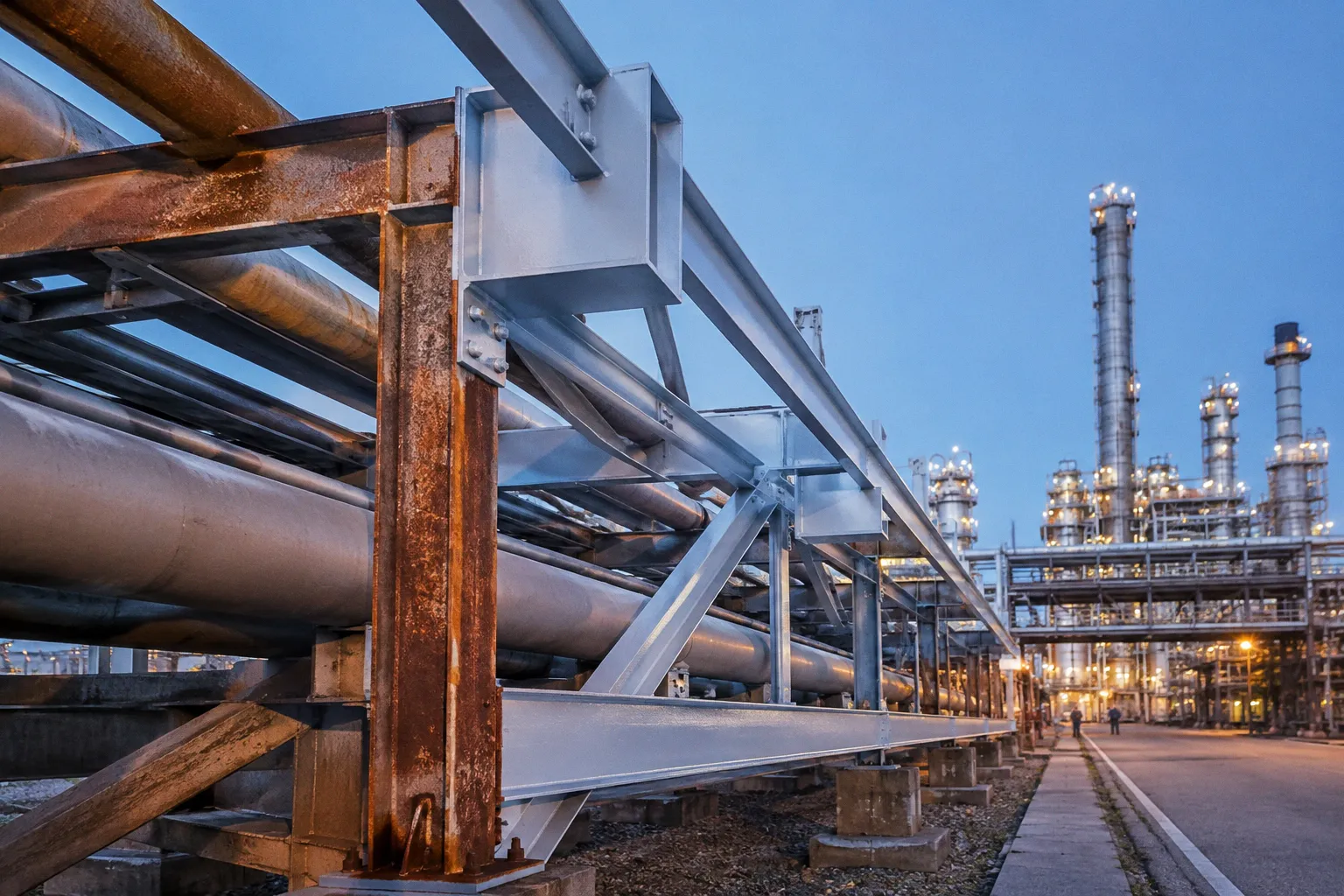
On a petrochemical pipe rack, corrosion begins quietly at the places where water, salts, process vapors, damaged coating, and poorly prepared surfaces remain trapped. By the time rust becomes visible across a flange, weld, base plate, or connection, the protective system has often been carrying more stress than the specification intended.
That is why petrochemical pipe rack steel coating selection cannot begin with a paint brand or a preferred color. It begins with the environment, the required durability, the geometry of the structure, and the way the steel will be fabricated, transported, installed, inspected, and maintained. A coating system is not a decorative skin placed over a finished frame. It is part of the asset’s corrosion strategy — and it needs to remain coherent from workshop prefabrication through years of exposure in the field.
Corrosivity is the first decision, not the last
ISO 12944 provides a practical language for describing atmospheric corrosivity. The categories are not simply labels for a site map; they describe how aggressively the surrounding environment can attack exposed steel. For petrochemical pipe racks, the choice often moves beyond ordinary industrial conditions because the structure may experience humidity, condensation, salts, chemical vapors, process emissions, splash, dust, and repeated wetting and drying.
The familiar categories include C3, C4, C5, and CX. Their significance becomes clearer when translated into the behavior of the steel itself:
| Corrosivity category | What it indicates | Why it matters for pipe racks |
|---|---|---|
| C3 | Moderate atmospheric exposure | May apply to less aggressive industrial or urban environments, depending on humidity and contamination |
| C4 | High corrosivity | Commonly relevant to industrial sites with significant humidity or pollution; coating thickness and barrier integrity become more demanding |
| C5 | Very high corrosivity | Associated with severe industrial or coastal exposure and an annual steel loss greater than 80 to 200 µm |
| CX | Extreme corrosivity | Represents the most aggressive atmospheric conditions in the classification, with an annual steel loss greater than 200 to 700 µm |
These categories should not be selected by habit. A pipe rack inside a petrochemical complex may have different exposures at different elevations and orientations. The underside of a horizontal member can retain moisture. A crowded pipe corridor can reduce drying. A structure close to cooling systems, marine influence, chemical handling, or persistent vapor release may need a more severe classification than a nearby frame in a cleaner, better-ventilated area.
The location of the steel is only one part of the picture. Its shape and access matter as well. Narrow gaps, intermittent welds, bolted crevices, sharp edges, stiffener intersections, drain paths, and areas beneath clamps can soften the effectiveness of an otherwise well-designed paint system. Corrosion protection settles into the details — quite literally — and the details need to be visible in the engineering and fabrication documents.
The right coating system does not begin with the topcoat. It begins with an honest description of the atmosphere touching the steel.
For a high-durability system under ISO 12944, the stated durability class is generally understood as more than 15 years to first major maintenance. That period is not a promise that the pipe rack will remain untouched for that length of time, and it is not a structural-life guarantee. It is a planning horizon for the coating’s performance before substantial maintenance is expected, assuming the system is correctly selected, applied, inspected, and exposed within the conditions for which it was designed.
That distinction matters in capital projects. A coating specification can be technically compliant and still be poorly suited to the real site if the corrosivity category is understated, if the structure contains unmanageable details, or if the planned maintenance environment was ignored at the design stage.
The three-layer defense: zinc, epoxy, and a UV-stable finish
The most common atmospheric protection system for heavy industrial steel uses three functional layers:
1. A zinc-rich primer.
2. An epoxy intermediate coat.
3. An aliphatic polyurethane topcoat.
Each layer carries a different part of the work. Together, they create a sequence that anchors to the prepared steel, builds a dense barrier, and protects the system from sunlight and weathering.
Zinc-rich primer: sacrificial protection at the steel surface
A zinc-rich primer does more than provide adhesion. Its zinc particles can protect the underlying steel cathodically, sacrificing the zinc before the steel begins to corrode. The resin binder holds the particles in the coating and helps protect them in acidic microenvironments.
This is especially valuable where the steel may experience a scratch, a small impact, or a localized failure in the upper layers. The primer is not permission to accept damage without repair, but it gives the coating system another line of defense. That reserve is useful on pipe racks because the structure is exposed to maintenance traffic, temporary access equipment, dropped tools, rigging contact, and the ordinary friction of a busy industrial site.
The primer also places strict demands on surface preparation. Rust, mill scale, oil, salts, dust, and moisture can interrupt the electrical and physical relationship between the zinc-rich layer and the steel. A nominally correct product applied over a contaminated or poorly prepared surface is not the same as a correctly functioning zinc-rich primer.
Epoxy intermediate coat: the barrier that holds the system together
Epoxy coatings provide chemical and abrasion resistance and form the principal barrier layer in many industrial coating systems. On a petrochemical pipe rack, that barrier helps separate the steel from atmospheric moisture and contaminants while giving the system the build needed for high-durability service.
Epoxy is strong in this role, but it has a clear limitation: it tends to chalk under sunlight. Chalked epoxy can lose appearance and may no longer provide the most stable exposed surface for an exterior structure. That is why an outdoor pipe rack should not rely on a standard epoxy layer as its final exposed coat when it is subject to solar radiation. A UV-resistant topcoat is needed to preserve the outer surface and protect the layers beneath it.
The intermediate layer also needs to follow the geometry of the structure without creating its own weaknesses. Excessive buildup around edges, runs in vertical members, pinholes, dry spray, and thin areas beneath brackets can all disturb the balance of the system. Smooth application is not a cosmetic ambition here; it is part of maintaining a continuous barrier.
Aliphatic polyurethane topcoat: the weather-facing layer
An aliphatic polyurethane topcoat is commonly used to provide UV and weather resistance. It protects the epoxy from direct sunlight and helps the entire system remain stable in exterior service.
Color retention may matter for inspection and site organization, but the deeper purpose is protection from the weathering that would otherwise reach the epoxy. The topcoat should be selected as part of the complete system rather than treated as an interchangeable finishing layer. Compatibility between primer, intermediate coat, and topcoat, along with the required recoat window and application conditions, should be established in the project specification and product data.
For a pipe rack in a petrochemical environment, the question is not simply whether the finish looks intact at handover. The more useful question is whether each layer is performing its intended task — sacrificial protection at the steel, barrier protection in the middle, and resistance to sunlight and weather at the surface.
Dry film thickness is a design parameter
Dry film thickness, or DFT, is one of the clearest ways to express how much protective material remains on the steel after application and curing. It is also one of the easiest parameters to misunderstand.
More coating is not automatically better. A system that is too thin may fail to provide the required barrier. A system that is excessively thick can develop its own problems, including poor curing, solvent entrapment, cracking, or adhesion difficulties, depending on the product and application conditions. The target is not a dramatic number; it is a controlled thickness distributed across the real geometry of the pipe rack.
For high-durability systems, the reference values in the available specification data include:
| Environment or system context | Indicative total dry film thickness |
|---|---|
| C3, high durability | 180–275 µm |
| C4, high durability | 260–380 µm |
| C4 zinc-rich epoxy primer | 60–80 µm |
| C4 high-build epoxy intermediate coat or coats | 80–150 µm |
| C4 aliphatic polyurethane topcoat | 50–75 µm |
The C4 range illustrates how the system is built in stages rather than poured onto the steel as one heavy layer. A zinc-rich epoxy primer of approximately 60–80 µm establishes the first protective relationship with the substrate. The high-build epoxy intermediate coat or coats add approximately 80–150 µm, and the aliphatic polyurethane topcoat contributes approximately 50–75 µm. The resulting total is typically in the range of 260–380 µm.
Those values are not a substitute for the approved coating manufacturer’s system data. They are a framework for specification and inspection. The final project documents still need to settle the exact product combination, application method, recoat intervals, environmental limits, and acceptance criteria.
Where thickness disappears
Pipe racks are rarely flat, open plates that can be coated with uniform ease. The coating may become thin at edges, corners, weld toes, bolt heads, underside surfaces, and areas where the spray pattern cannot reach comfortably. These are the places where a nominal total DFT can conceal local weakness.
A sound inspection approach therefore looks beyond an average reading. It considers:
- Whether the steel surface was adequately prepared before priming.
- Whether edges and welds received the specified treatment.
- Whether difficult-to-access surfaces were coated continuously.
- Whether each coat cured within the manufacturer’s permitted interval.
- Whether the measured DFT corresponds to the intended layer sequence.
- Whether repairs after transport and erection restore the complete system rather than only covering visible rust.
The workshop and the site also create different coating conditions. In a fabrication shop, the steel can often be cleaned, blasted, coated, and inspected under more stable conditions. At the installation site, wind, dust, humidity, condensation, restricted access, and nearby operations may narrow the application window. That is one reason structural steel prefabrication coating standards need to be connected to the erection and repair plan instead of being written as an isolated workshop procedure.
Prefabrication changes the coating conversation
Heavy petrochemical steelwork is often fabricated in sections, modules, frames, or assemblies before it reaches the site. This can improve dimensional control and reduce the amount of work performed at elevation, but it also creates transitions in the protective system.
A shop-applied coating may be damaged during lifting, loading, transport, temporary storage, bolting, field welding, and final alignment. Connection zones may be intentionally left uncoated or partially coated until installation. Field welds will need their own preparation and coating sequence. Areas hidden after assembly may have to be treated before access closes.
A coherent specification should therefore divide the system into three connected phases:
Before fabrication
The steel condition, surface preparation route, edge treatment, weld finishing, and primer application need to be defined before pieces disappear into assemblies. If the coating specification arrives after fabrication decisions have been fixed, the most difficult surfaces will already be difficult.
During workshop production
The fabricator needs a repeatable method for controlling surface cleanliness, blast profile where applicable, environmental conditions, mixing, application, curing, and DFT. The goal is not merely to apply the listed products. It is to produce a surface that can survive the next stage without losing continuity.
After erection
Field repair should be treated as part of the original corrosion design. Damaged zones need to be brought back to sound coating, cleaned, and rebuilt with compatible materials. The repair should restore the intended primer, barrier, and topcoat functions where those layers have been removed or compromised.
This is where industrial steel pipe rack corrosion protection either settles into a dependable rhythm or begins to fracture into exceptions. A system designed only for the shop will not remain a system once cranes, bolts, welders, weather, and maintenance crews begin touching it.
Polysiloxane systems: fewer coats, not fewer responsibilities
Polysiloxane coatings can allow a two-coat arrangement — commonly a zinc primer followed by a polysiloxane layer — instead of the traditional three-coat combination. The attraction is clear: fewer application stages can reduce labor and simplify the sequence while still providing UV and weather resistance.
That efficiency can be meaningful on large pipe racks, where the coating area is extensive and access is expensive. Fewer coats may reduce handling, staging, waiting between applications, and the number of transitions that must be inspected.
But the reduction in coat count should not be confused with a reduction in performance requirements. A two-coat system still depends on:
- Correct environmental classification.
- Compatible primer and polysiloxane products.
- Proper surface preparation.
- Controlled application thickness.
- Adequate coverage at edges, welds, corners, and connections.
- Repair procedures that can be carried out with materials approved for the system.
The advantage is therefore logistical as much as chemical. Polysiloxane may offer a more compact application sequence, but it does not make the steel indifferent to moisture, contamination, impact, or poor detailing. The structure still needs to be prepared so that the coating can settle, anchor, and remain continuous.
A shorter coating schedule is useful only when it stays a complete corrosion system — not when it quietly removes one of the system’s functions.
The decision between a traditional zinc–epoxy–polyurethane arrangement and a zinc–polysiloxane system should be made against the project’s real constraints: corrosivity, exposure to sunlight, chemical contact, abrasion, access, production rate, repair strategy, and the availability of qualified application and inspection resources.
Chemical exposure and abrasion need a separate look
Atmospheric classification provides a necessary foundation, but petrochemical structures can encounter more than ordinary atmospheric corrosion. A pipe rack may be near process lines, drains, vents, loading areas, washdown zones, or maintenance operations. The coating can face chemical deposits, abrasive dust, impact, and repeated contamination even when the general site classification appears manageable.
Epoxy is valued for chemical and abrasion resistance, which is one reason it remains central to many heavy industrial coating systems. Yet the outermost layer still has to face sunlight. A system that performs well chemically but leaves an exposed epoxy surface may chalk under UV exposure. Conversely, a UV-stable finish chosen without considering chemical conditions may not provide the most balanced protection for the specific service.
The design conversation should separate at least three forms of exposure:
Atmospheric exposure
This is the broad environmental condition described through the ISO 12944 corrosivity category. It includes the general influence of humidity, pollution, salts, and wetting cycles.
Local process exposure
This concerns the substances and conditions that may reach the coating near equipment, valves, drains, vents, or process areas. The specification should avoid assuming that every surface on the rack experiences the same environment.
Mechanical exposure
This includes impact from maintenance work, abrasion from access systems, friction during installation, and damage from transport or temporary supports. A coating system that is excellent in a laboratory-like atmospheric condition can still fail early if the structure is repeatedly struck or scraped and the repair process is weak.
The available fact base does not establish universal chemical-resistance performance figures for every proprietary polysiloxane and aliphatic polyurethane product. That is a useful boundary, not a missing detail to be filled with confident-sounding numbers. Product-specific chemical exposure data belongs in the approved technical documentation, tied to the actual substances, concentrations, temperatures, and contact conditions expected at the facility.
Detailing the steel so the coating can do its work
Coating selection cannot rescue geometry that continuously traps water or prevents access. On pipe racks, the protective system becomes more reliable when the steelwork is detailed with drainage, inspection, application, and future maintenance in mind.
That may mean reducing narrow crevices, avoiding unnecessary pockets where moisture can remain, treating sharp edges so the film does not pull thin, and providing practical access to surfaces that must be inspected or repaired. Welds should be continuous and finished in a way that does not leave abrupt transitions or embedded contamination. Bolted connections require particular attention because contact surfaces, bolt heads, nuts, and surrounding edges may create sheltered corrosion points.
This does not turn a coating specification into a structural-design manual. It simply recognizes the physical truth of industrial steel: the coating follows the surface it is given. If the surface holds water, the coating is asked to defend a wet pocket. If the edge is sharp, the coating is asked to remain full over a place where films naturally become vulnerable. If a zone is inaccessible after assembly, the project is asking future maintenance to solve a problem that should have been settled earlier.
A more settled approach brings the fabricator, coating specialist, structural engineer, and construction team into the same sequence. They do not need to use the same vocabulary, but they do need to agree on where the system begins, where it is interrupted, how it is restored, and what evidence will show that it remains intact.
A practical selection path for a petrochemical pipe rack
The selection process can be kept clear without becoming mechanical. The following sequence helps move from environmental reality to an applicable specification:
1. Describe the exposure rather than naming the facility.
Record humidity, pollution, marine influence, chemical vapors, condensation, splash, and the possibility of extreme local conditions. A petrochemical site is not automatically uniform.
2. Assign the corrosivity category that matches the service.
Use the ISO 12944 framework to distinguish moderate, high, very high, and extreme exposure. Do not choose C4 or C5 merely because it is familiar; connect the category to the actual environment.
3. Set the durability objective.
If the project is targeting high durability, the planning meaning is more than 15 years to first major maintenance — not a promise of maintenance-free structural life.
4. Choose the layer functions.
Decide whether the system requires the traditional zinc-rich primer, epoxy barrier, and aliphatic polyurethane topcoat, or whether a qualified polysiloxane arrangement is more suitable.
5. Match the system to the geometry.
Review edges, welds, stiffeners, underside surfaces, bolted connections, crevices, access limitations, and areas that will become hidden after assembly.
6. Set DFT by coat and in total.
A total figure without layer control can hide a weak primer, a thin barrier, or an overstressed topcoat. The C4 high-durability range of approximately 260–380 µm should be understood through its separate coat functions.
7. Carry the specification through fabrication and erection.
Define shop application, transport protection, field weld treatment, damage repair, inspection, and final acceptance as one continuous process.
8. Leave product-specific claims to product-specific evidence.
Chemical resistance, compatibility, recoat windows, and application limits should come from the approved system documentation rather than from generic assumptions about a coating family.
This path gives the project something more useful than a list of products. It creates a chain of decisions that can be followed when the structure changes, when a module is delayed outdoors, or when a field repair exposes more damage than expected.
Let the protection settle into the whole structure
The strongest petrochemical steel pipe rack coating specification is not the one with the most layers or the longest product description. It is the one that remains intelligible when the steel moves from design drawings to the fabrication shop, from the shop to transport, and from transport into a crowded operating facility.
ISO 12944 helps establish the environmental language. Zinc-rich primers provide sacrificial protection. Epoxy builds chemical and abrasion resistance. Aliphatic polyurethane or polysiloxane protects the exposed surface from UV and weather. DFT gives the system a measurable body. Detailing, inspection, and repair allow that body to remain continuous after fabrication and installation.
The work is deliberate — prepare the steel, build the layers, protect the edges, inspect the transitions, restore the damaged places, and keep the maintenance plan close enough to the design that neither has to reach for the other later. When those decisions stay connected, corrosion protection becomes less of a final paint operation and more of a stable, breathing part of the industrial structure.