Kammprofile vs Spiral Wound Gaskets in Petrochemical Service
A flange joint fails not because the gasket was inadequate, but because its structural behavior was mismatched to the operating load profile.
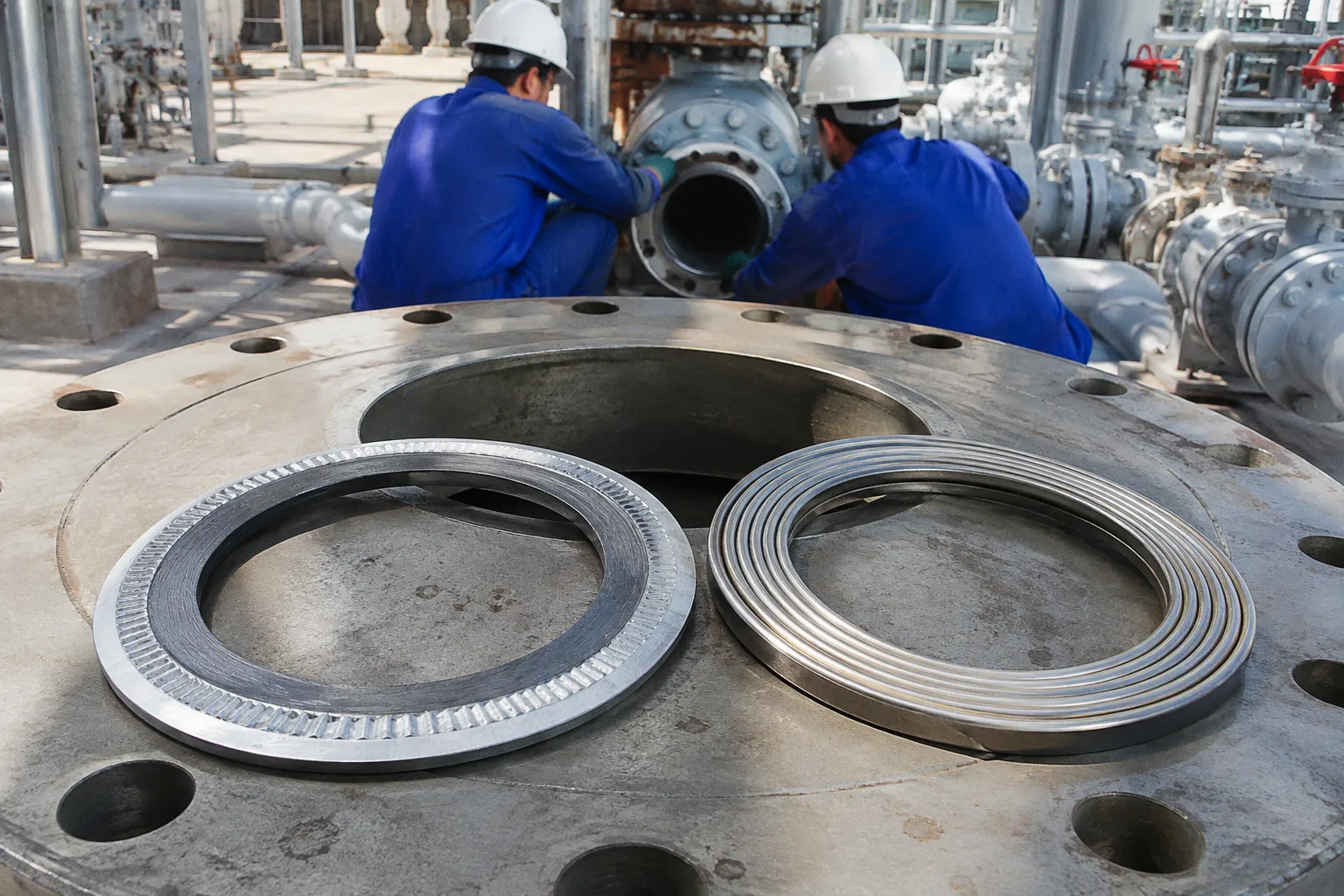
Kammprofile vs. Spiral Wound Gaskets in Petrochemical Service
In refinery heat exchangers, reactor nozzle connections, and high-pressure process piping, the decisive variables are often bolt-load distribution, flange rotation, thermal cycling, surface condition, and the gasket's ability to retain its geometry during installation.
That is why the comparison of kammprofile vs spiral wound gasket high pressure service cannot be reduced to filler material or nominal pressure class. A spiral wound gasket and a kammprofile gasket transfer compressive load through fundamentally different structures. One depends on a controlled stack of wound metal and filler layers. The other uses a solid metallic core with serrated sealing faces. The difference affects blowout resistance, handling, leakage behavior, and the practical cost of a turnaround.
Spiral wound gaskets remain the standard choice for a large portion of petrochemical piping. They are widely available, familiar to maintenance teams, and covered by established dimensional and material requirements in ASME B16.20 for the gasket constructions included within its scope. Kammprofile gaskets, also known as grooved or serrated metal gaskets with covering, are likewise addressed within the applicable editions of ASME B16.20, where the standard establishes the basic dimensional, marking, and material framework for that product family. Project-specific geometry, facing thickness, serration pattern, and any additional requirements are typically supplemented through the manufacturer specification, project standard, or other governing requirement called up by the purchaser.
The engineering question is therefore not which gasket is universally better. It is which load path is more tolerant of the actual joint.
The sealing interface is a mechanical system. Gasket geometry determines how the joint fails under load; filler chemistry alone does not.
Structural Mechanics: Solid Core vs. Wound Metal Layers
The architectural difference between the two gasket types governs nearly every downstream performance characteristic.
A spiral wound gasket is made from alternating plies of thin metallic strip and compressible filler wound around a central opening. The metal may be stainless steel, nickel alloy, or another material selected for temperature and chemical compatibility. Common fillers include flexible graphite, PTFE, and mica-based materials for service where temperature or oxidation resistance is important.
The metal strip provides resilience and structural support. The filler closes the microscopic irregularities in the flange faces and provides much of the gasket's conformability. During bolt-up, the winding stack is compressed between the flanges. The metal and filler respond together, but they do not behave as a single homogeneous body. The gasket's final performance depends on winding tension, strip and filler dimensions, winding density, compression, recovery, and the uniformity of the applied bolt load.
The rings around a spiral wound gasket have different jobs and should not be treated as interchangeable. The outer guide ring is primarily a centering and handling component. It helps locate the gasket in the flange assembly, limits outward movement of the winding, and can provide a reference for installation. It is not the principal restraint against inward buckling.
Where an inner ring is specified, it supports the winding at the inside diameter, limits radial movement toward the bore, and helps protect the filler from direct exposure to the process stream. That inner ring is the primary structural feature resisting inward buckling of the winding. It can also improve resistance to turbulence, erosion, and chemical attack at the gasket's inner edge. Whether an inner ring is required depends on the service, pressure, temperature, gasket construction, and the applicable specification.
A kammprofile gasket follows a different mechanical logic. Its core is a solid metallic ring or disc machined with concentric serrations on the sealing faces. A thin layer of flexible graphite, PTFE, or another facing material is applied over the serrated surfaces. The metallic core carries the main compressive load, while the facing fills surface irregularities and creates the final leak-tight interface.
The load path is comparatively direct:
- bolt load enters the solid metal core;
- the core transfers that load through the serration peaks;
- the facing deforms into the flange surface;
- the compressed facing blocks leakage across the joint.
There are no wound plies to unwind and no alternating filler layers that can shift relative to one another. The kammprofile core can still be damaged by excessive compression, flange misalignment, corrosion, or impact, but its dimensional stability comes from a continuous metallic structure rather than from the integrity of a wound composite.
| Parameter | Spiral Wound Gasket | Kammprofile Gasket |
|---|---|---|
| Core structure | Alternating wound metal strip and filler layers | Solid machined metallic core with serrated faces |
| Primary sealing action | Filler compressed between metal windings | Soft facing compressed and formed by serrations |
| Main load-bearing element | Wound metallic structure and support rings | Monolithic metallic core |
| Inward radial restraint | Primarily provided by the inner ring when fitted | Inherent in the continuous core geometry |
| Outer ring function | Centering, handling, and outward restraint of the winding | Usually a centering or locating component when supplied |
| Typical vulnerability | Winding displacement, filler extrusion, buckling, or spring-back | Facing damage, serration damage, core distortion, or corrosion |
| Reuse potential | Normally treated as single-use | Core may be refurbished if inspected and approved |
The distinction matters particularly in a high pressure heat exchanger gasket comparison. A spiral wound gasket can perform reliably when its construction, ring arrangement, flange condition, and bolt-up procedure are properly controlled. A kammprofile gasket is not automatically immune to installation error, but its solid core gives it a different margin against geometric instability.
Blowout Resistance and Dimensional Integrity in High-Pressure Service
At elevated pressure and temperature, the gasket must do more than fill surface roughness. It must retain its position and sealing load while the joint experiences pressure thrust, thermal expansion, flange rotation, vibration, and changes in bolt tension.
The required seating load can be substantial in large flanges and high-pressure classes. The exact value depends on gasket construction, flange stiffness, bolt pattern, materials, operating conditions, and the design method used. It is not enough to assume that a larger torque value will compensate for an unsuitable gasket. Excessive bolt load can crush the gasket or distort the flange, while insufficient or uneven load leaves leakage paths in the sealing interface.
A spiral wound gasket responds to this environment as a composite structure. The windings must remain sufficiently compressed and correctly positioned for the filler to maintain contact with both flange faces. If the bolt load is uneven, parts of the gasket may be over-compressed while other areas remain below the required seating stress. The result can be localized filler extrusion, winding displacement, or loss of recovery during thermal cycling.
The inside diameter is a particularly important region. Process pressure acts near the bore and can interact with the gasket's radial stiffness. Without suitable inward support, the winding can move toward the bore or buckle under a combination of compression, pressure, and installation disturbance. An inner ring, when required by the gasket design and service conditions, provides that support. The outer ring does not perform the same function; it centers the assembly and helps restrain movement toward the outside diameter.
Springing is the field term often used for a spiral wound gasket that has lost its intended winding geometry or springs back during bolt-up. It may be associated with rough handling, inadequate support, poor winding quality, excessive compression, or a bolt-up sequence that loads the gasket unevenly. A gasket that appears intact before installation can still have a compromised internal structure.
The risk generally increases as gasket diameter, stiffness, and handling difficulty increase. Large-diameter flanges are more difficult to align and bolt uniformly. The gasket may be lifted, carried, or positioned in a way that introduces bending. A long unsupported span can flex under its own weight, and the damage may not be obvious once the gasket is placed between the flanges.
A kammprofile gasket has no wound stack to buckle or unwind. Its solid core retains its plan shape under loads that would challenge a layered construction. That does not mean that the gasket can tolerate unlimited compression. Serrations can flatten, the facing can be squeezed out, and the core can be permanently distorted if the flange assembly is overloaded or misaligned. But the failure mechanism is different: there is no inter-ply separation because there are no inter-ply interfaces.
For a high-pressure joint, this difference is valuable when the installation environment cannot guarantee perfectly uniform bolt loading. It is not a substitute for controlled bolting. It is an additional structural margin.
The inner ring supports the bore side of a spiral wound gasket; the outer ring centers and guides the assembly. Confusing those functions leads to the wrong diagnosis when a gasket buckles inward.
Blowout resistance also depends on the relationship between the gasket and the flange. A gasket cannot compensate for excessive flange rotation, inadequate bolt engagement, poor stud quality, or a joint that opens under pressure. The correct comparison is therefore between complete joint designs, not isolated catalogue claims.
Handling and Installation Risks for Large-Diameter Flanges
Gasket selection is often discussed as though the only important moment is the operating cycle. In practice, many failures are introduced earlier, during storage, transport, alignment, and bolt-up.
A small spiral wound gasket is relatively easy to support and position. A large-diameter gasket is more vulnerable to bending and impact. The outer guide ring may help with centering, but it does not make the wound element immune to distortion. If the gasket is lifted from an unsuitable point, dragged across a flange, placed against a sharp edge, or allowed to flex under its own weight, the winding can be disturbed before the bolts are installed.
Damage may include:
- displacement of the winding relative to the guide ring;
- local flattening of the winding or filler;
- distortion of the inner ring;
- separation or loosening of the filler at the bore;
- ovality that prevents uniform contact around the flange;
- contamination of the sealing faces with oil, scale, or loose graphite.
Visual inspection remains necessary, but it is not always sufficient. A gasket can look acceptable while carrying a local defect that becomes a leakage path after pressurization. Large-diameter spiral wound gaskets therefore require support over their circumference, careful lifting, clean storage, and inspection against the drawing or purchase specification before installation.
The installation sequence matters as much as the gasket's condition. The flange faces should be aligned without forcing the gasket into position. Studs should be engaged without dragging the flange across the gasket. The initial tightening sequence should bring the flanges together progressively, followed by a controlled cross-pattern or the procedure specified for the joint. Final bolt tension should be verified with a suitable method for the criticality and size of the connection.
Kammprofile gaskets are less vulnerable to bending because the metallic core is continuous. The core is not immune to impact: a drop onto a serrated face can flatten or damage the profile, and a dent at the inner or outer edge can affect seating. The facing is also relatively soft and must be protected from abrasion, oil contamination, and handling marks.
The practical advantage is that a kammprofile gasket is less likely to lose its basic geometry during normal movement. The core can be lifted and positioned with greater confidence, provided it is supported correctly and the serrations are not dragged across the flange. This advantage becomes more relevant as diameter increases and as the gasket must be installed in a restricted maintenance area.
For either design, the flange faces should be examined for:
1. radial scratches that cross the sealing path;
2. pitting or corrosion deeper than the facing can accommodate;
3. dents near the bore or bolt circle;
4. residual gasket material that prevents uniform contact;
5. excessive flange rotation or visible distortion;
6. mismatch between the specified gasket dimensions and the actual flange facing.
A new gasket cannot repair a damaged flange face. Nor can a stronger gasket solve a joint that has been assembled with poor alignment.
Kammprofile Gasket Leakage Troubleshooting
Leakage troubleshooting is easier when the physical failure mode is identified instead of treating every leak as a generic gasket problem.
A leak from a spiral wound gasket may indicate uneven compression, winding damage, incorrect ring selection, filler incompatibility, insufficient seating load, or loss of load during thermal cycling. Leakage concentrated near the inner diameter should prompt inspection of the bore-side winding and inner ring. If the gasket has moved toward the bore, the investigation should consider inner-ring support, flange alignment, pressure direction, and the condition of the winding before installation.
Leakage around one sector of the flange often points to non-uniform bolt load or flange distortion. The bolt pattern, stud condition, lubrication practice, tightening sequence, and flange stiffness should be reviewed together. Replacing the gasket without correcting the load distribution can produce the same leak on the next cycle.
A kammprofile leak has its own diagnostic pattern. The core may be sound while the facing has been damaged, contaminated, over-compressed, or locally removed. Serrations that have been flattened unevenly can leave a band with insufficient facing pressure. Corrosion under the facing can create a discontinuity that is not visible until the gasket is dismantled.
During disassembly, the gasket should be examined before it is discarded. Useful evidence includes:
- whether the facing transferred evenly around the circumference;
- whether compression marks are continuous on both sides;
- whether one area shows little or no contact;
- whether the serrations are flattened uniformly;
- whether the core has bent, cracked, or suffered corrosion;
- whether the gasket was displaced relative to the flange bore.
A kammprofile core that remains dimensionally sound may be a candidate for refurbishment, but that decision requires inspection and approval against the applicable repair procedure. A core that has been chemically attacked, plastically distorted, or severely damaged should not be returned to service simply because it looks recoverable after cleaning.
Troubleshooting should also distinguish gasket leakage from valve, weld, or flange-body leakage. In a pressurized process system, the apparent source may be downstream of the actual defect. Safe isolation and inspection procedures remain essential; no gasket comparison changes the requirements for depressurization, decontamination, and permit control.
Refurbishment Potential and Lifecycle Cost Analysis
One of the less visible advantages of the kammprofile design is the potential to refurbish the metallic core.
A spiral wound gasket is normally treated as a single-use component. Once compressed, the winding geometry and filler condition cannot be reliably restored to a known state. The gasket is removed, inspected as evidence if useful, and replaced. That simplicity supports fast turnarounds and predictable inventory, but it places the entire cost burden on each shutdown.
A kammprofile core can be reclaimed in many cases. The spent facing is removed, the serrations are inspected for flattening or corrosion, and a new facing is bonded onto a sound core. The economic case depends on core diameter, materials, facing cost, turnaround timing, and whether the project has a controlled repair procedure in place. For larger diameters, the savings can be substantial because the raw machined core represents the most expensive part of the assembly and the facing is a comparatively thin layer of consumable material.
Refurbishment is not free. Inspection, cleaning, surface preparation, recoating, and final dimensional checks all take time and labor. The decision becomes a tradeoff between core replacement cost and the cost of a controlled refurbishment cycle. On small-diameter joints, the labor content of refurbishment can erode the savings. On large-diameter joints with expensive alloys, refurbishment often wins.
Lifecycle cost analysis should also consider:
- inventory carrying cost of finished gaskets versus cores and facing stock;
- scrap rate of cores returned from service;
- storage life of replacement facings;
- qualification work needed to approve a repair procedure;
- documentation and traceability required by the quality system.
For both designs, the dominant cost driver in a high-pressure service is rarely the gasket alone. Bolt rework, flange machining, stud replacement, and the opportunity cost of an unplanned outage usually outweigh the gasket line item. The right comparison is total installed cost over the life of the joint, not the unit price of one component.
Compliance with ASME B16.20 and Flange Surface Finish Standards
The selection between kammprofile and spiral wound gaskets cannot be made without reference to the standards that frame their manufacture, identification, and use. ASME B16.20 applies to both spiral wound gaskets and to kammprofile (grooved or serrated) metal gaskets with covering, within the scope defined by the applicable edition. The standard establishes dimensional conventions for the gasket types it covers, basic material expectations, and marking requirements that allow the installer to confirm the product against the purchase order.
Where ASME B16.20 addresses a kammprofile gasket as a serrated metal gasket with facing, the standard provides the basic dimensional envelope and identification rules, but it does not replace the manufacturer's controlled geometry for serration profile, facing thickness, bonding procedure, or hardness. Those details are typically supplied by the manufacturer and verified through project specifications, inspection and test plans, or supplementary standards referenced in the datasheet.
Spiral wound gaskets sit within the same ASME B16.20 framework, with established dimensional tables for standard sizes, ring arrangements, and identification markings. Compliance verification therefore follows a familiar path: check the marking against the order, confirm the dimensional class against the flange, and review the material certificates.
Flange surface finish is the second half of the compliance picture. A gasket cannot perform against a surface that exceeds its conformability. Typical requirements include:
- a surface roughness within the range specified for the chosen gasket style;
- freedom from radial tool marks, scratches, or grooves that cross the sealing path;
- absence of pits, corrosion product, or embedded debris;
- flatness and parallelism consistent with the joint design;
- compatible flange face type (raised face, tongue and groove, male and female, ring joint) matched to the gasket style.
Spiral wound gaskets generally tolerate a wider range of surface conditions because their filler conforms to the micro-geometry of the flange face. Kammprofile gaskets depend on a thinner facing layer and a more controlled serration depth. They are more sensitive to surface defects that exceed the conformability of the facing and may require a tighter surface finish specification, particularly in high-pressure, high-cycle service.
The practical conclusion is that both gasket types benefit from a documented flange surface specification, a method for verifying finish on receipt of new flanges and after refurbishment, and a clear pass/fail criterion for in-service faces during turnaround. Standards and surface finish are not separate topics; together they define whether the chosen gasket has a fair chance of sealing the joint it was purchased for.