Distillation Column Pre-Dressing: Is It Worth It?
The question lands on every project engineer's desk long before a heavy-lift contractor rolls onto site: do we fully dress this column on the ground, or finish it in the air?
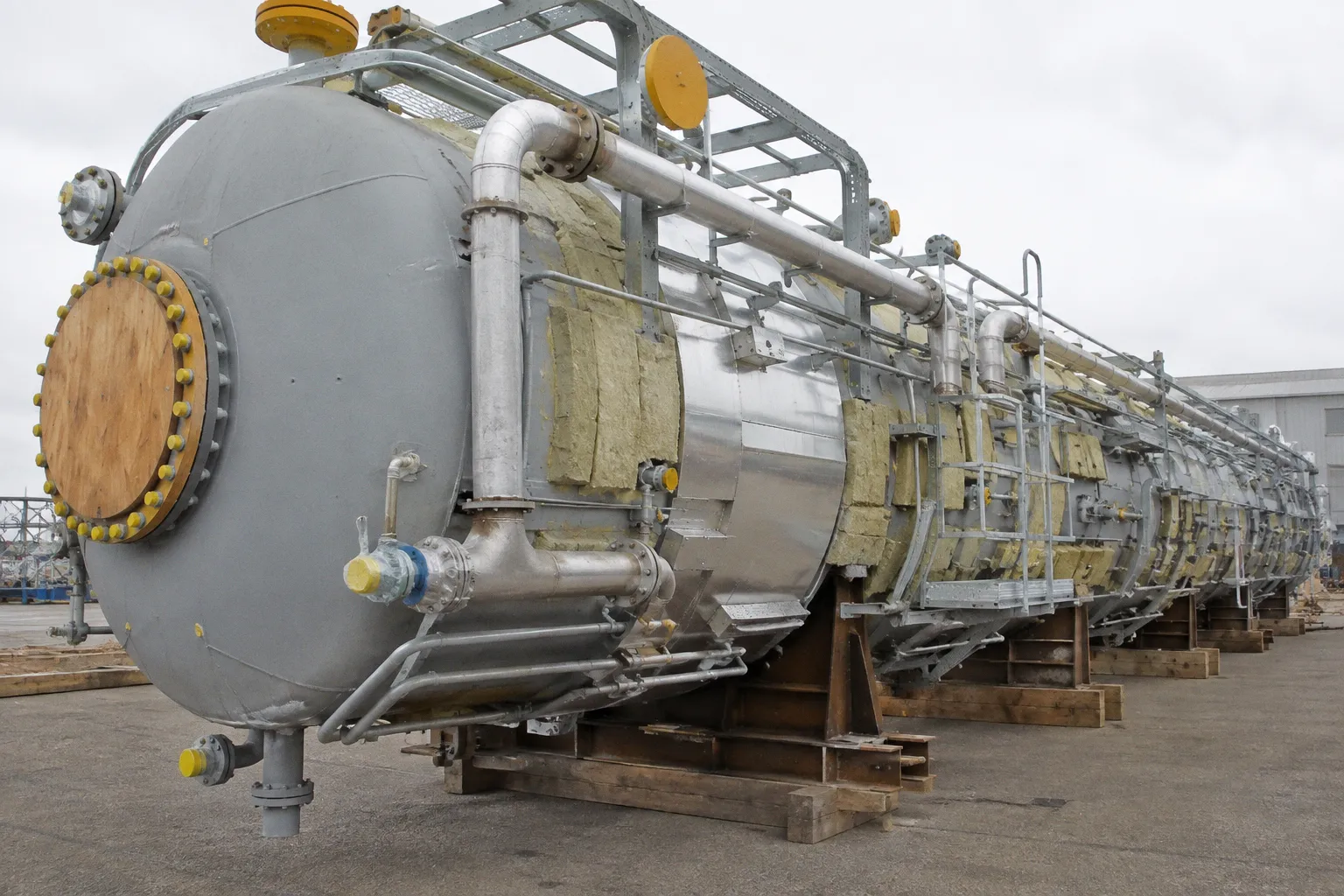
Pre-dressing — installing ladders, platforms, insulation cladding, attached piping, cable trays, and select nozzle valves while the vessel still lies horizontal on its erection saddles — sounds like an obvious win. Work moves from elevated decking down to grade, where crews can move freely, welders can run uninterrupted passes, and inspectors can reach every seam without a harness. The complication, and it is not a small one, is that everything bolted on at grade must then be lifted as part of the rigging load — and the vessel itself has to rotate cleanly from horizontal to vertical without leaving anything behind on the hardstand.
That single decision reshapes three engineering streams at once: the lift study, the rigging geometry, and the erection sequence. Get it right, and a column arrives standing with most of its outfitting already in place — a self-contained module that ties into the surrounding structure with minimal follow-on work. Get it wrong, and the same decision costs a week of crane stand-by, a re-spec of the rigging, or worse — a damaged internal tray discovered only after the hydrostatic test.
The Weight Penalty and the Crane Capacity Question
Every kilogram of insulation, every meter of platform grating, every cable tray section that lands on the column at grade becomes dead weight during the critical lift — and dead weight that sits at variable radii from the rigging centerline as the column rotates from horizontal to vertical. The math is unforgiving. Column pre-dressing before lifting can swell the gross lift by tens of tonnes depending on vessel size, and the crane chart that looked comfortable at bid stage suddenly needs re-evaluation against a heavier load with a shifting center of gravity.
This is where many projects discover that "saving time at height" carries an upfront cost in lift engineering. The crane capacity table has to be regenerated. The ground bearing pressure under the outrigger pads — and under the column itself during the rotation phase — has to be reassessed, because pre-dressed columns concentrate load differently than bare shells. The boom configuration may shift from a single main lift to a tailing arrangement with an assist crane, simply to control the horizontal-to-vertical rotation. Rigging selection moves from a standard sling set to a custom spreader beam or trunnion arrangement, and the engineered lift plan — the document every safety authority wants signed off before a load leaves the ground — has to be rewritten from the rigging sketch up.
The trade-off still tends to favor pre-dressing, but only when the lift envelope was planned with pre-dressing in mind from the bid stage. Retrofitting a pre-dressing decision into a crane selection that has already been frozen is where schedules start to slip — and where the cost of "saving time" quietly turns into the cost of re-engineering the lift.
Internal Trays and the Hidden Risk of Rotation
External appurtenances are forgiving. They can be strapped down, blocked, and re-aligned after erection with relative ease. Internal trays — the mass-transfer components that actually do the column's job — are not. They are tuned to operate in a vertical flow regime, with liquid and vapor moving counter-current through structured or random packing under normal operating conditions. During a vertical rotation lift, those same trays experience lateral forces they were never designed to absorb.
Internal trays that survive a horizontal-to-vertical rotation intact do so by luck of geometry — not by engineered margin.
For certain tray configurations — particularly floating-valve assemblies, loose random packing, and bolted sieve tray panels — pre-installation at ground level is simply not recommended. The tray panel can shift under the bending loads imposed by the slings, especially near the lift points where the bending moment peaks. A dislodged tray discovered only after the column has been set, aligned, and pressurized can take a unit down for weeks while the internals are extracted through the manways, repaired, and re-installed.
The conservative practice is to limit pre-dressing to external outfitting, and to leave all internal tray installation for the post-erection phase when the column is vertical, hydrostatically tested, and ready for commissioning. Where internal components must go in before erection — for example, when a packed section is sealed inside the vessel for shipping efficiency — they should be specifically engineered and braced for the lift configuration, not assumed to survive by the same margin as the external cladding.
Alignment Sights and the Practicalities of Ground Insulation
Insulation is the workhorse of any pre-dressing campaign, and it is also where the on-site choreography gets delicate. A column that arrives at its final position fully insulated saves days of scaffolding erection around the vessel, but it cannot arrive fully insulated — the rigging crew needs to see what they are doing. The convention, well established across refinery and petrochemical sites, is to leave alignment sights open: a minimum of two rows at two separate locations along the column, where the insulation jacket and cladding are held back so the rigging supervisor can confirm vessel orientation and the alignment marks remain visible during setting.
This sounds like a small detail. In practice, it shapes the sequencing of the entire insulation subcontract. The ground insulation crew must understand which windows must remain open until the column is vertical, and which can be closed immediately after the slings are released. The post-erection insulation crew then has to remobilize to seal those alignment sights — finite scope, but real work that has to be priced and scheduled into the construction sequence. Engineers who have run these numbers usually describe it as roughly cost-neutral, with the real savings showing up only when the column is in a congested plot where access scaffolding would otherwise dominate the man-hour budget.
| Pre-Dressing Element | Pre-Erection Scope | Post-Erection Completion |
|---|---|---|
| External ladders and cages | Full installation | Final tie-in welds only |
| Platforms and grating | Pre-assembled modules bolted on | Bolted connections to structure |
| Insulation cladding | Jacket applied with alignment sights open | Sight windows closed after setting |
| Piping and instrument branches | Pre-trimmed and clamped, where geometry permits | Final field welds and supports |
| Cable trays and electrical | Brackets pre-installed, tray sections pre-mounted | Final routing and termination |
| Top-mounted nozzle valves | Mounted and pressure-tested at grade | Final bolt-up to interconnecting piping |
Case Studies: How Far the Practice Has Been Pushed
The bound on pre-dressing is not theoretical. It has been tested, repeatedly, in refinery debottlenecking work and modular plant construction — and the record keeps moving outward.
In 2018, the heavy-lift contractor Sarens executed eleven pre-dressed columns at the NIS refinery in Serbia as part of a debottlenecking campaign. The vessels ranged from 25 to 40 meters in length and from 20 to 90 tonnes in lifted weight — a deliberate choice to compress the critical path by consolidating work at grade. The trade-off was an aggressive lift study, with multiple assist cranes configured to manage the horizontal-to-vertical rotation of the larger vessels inside a congested plot. The pre-dressing scope paid off because the lift envelope had been engineered for it from the start — not retrofitted after the fact.
Larger still, the absorber column case documented by Mammoet reached 55 meters in length and roughly 100 tonnes of total erection weight. At that scale, the lift envelope stops being a routine crane chart exercise and becomes a heavy-lift engineering project in its own right — ground bearing analysis, custom rigging, wind-velocity cut-offs evaluated on a project-by-project basis rather than from a generic table, and continuous monitoring through the rotation phase. The pay-off was a single erection event that left the column standing with most of its external outfitting already integrated, ready to tie into the surrounding structure with minimal follow-on work at height.
Going further back, the 1992 completion of the Alberta EnviroFuels MTBE plant remains a benchmark for what pre-dressing can compress — a tight construction window where multiple distillation columns were dressed at grade and erected in sequence to keep the schedule inside a single turnaround season. The structural steel and process equipment trades coordinated through ground-level work, and the elevated work shifted to tie-ins and trim rather than primary outfitting.
What these projects share is discipline: the lift study, the insulation sequencing, and the internal tray protection were all engineered before the first column was rolled onto its saddles. Pre-dressing was not improvised on the fly.
Where Pre-Dressing Stops Paying Off
There are real limits, and a competent project team recognizes them early rather than discovering them mid-lift.
1. When ground hardstand is inadequate. A pre-dressed column at 100 tonnes concentrates load along the saddle line — and during rotation, that load migrates. If the laydown yard was not designed for those forces, the hardstand can fail, and the column becomes an expensive piece of equipment sitting at an angle it was never meant to be in.
2. When internal tray geometry is unforgiving. Packed beds, structured packing, and certain valve-tray configurations do not tolerate the bending loads of a horizontal-to-vertical rotation. These columns should be dressed externally only, and opened up only after erection is complete.
3. When the lift envelope was never re-engineered. If the crane was selected for a bare-shell weight and the pre-dressing decision was made later, the rigging and crane configuration may no longer be valid — and a forced fit usually ends with the lift going on weather hold or being re-bid at premium rates.
4. When access scaffolding would have been cheap anyway. On a greenfield site with open ground and a clear plot, full ground dressing may not save enough hours to justify the engineering overhead. The math favors pre-dressing most strongly when the eventual erected position is congested, elevated, or otherwise difficult to reach.
Pre-dressing is not a productivity lever to be pulled on every column — it is a design choice that should be made at the bid stage and respected through the lift study.
The Position
Pre-dressing, done deliberately, is one of the few practices in heavy industrial construction that genuinely compresses both schedule and risk at the same time. It moves elevated work to grade, where it is faster and safer, and it concentrates the most labor-intensive outfitting into a phase where crews can work without harness lines or wind restrictions. The lift envelope gets heavier, the rigging gets more complex, and the engineering overhead rises — but on any project where the column's final position is congested or elevated, that overhead is paid back several times over in compressed man-hours and reduced work-at-height exposure.
The mistake is to treat pre-dressing as a field decision. By the time a column is on its saddles, the major variables — crane selection, rigging geometry, insulation sequencing, internal tray protection — should already be settled and signed off. Pre-dressing that was not engineered into the lift plan from the beginning tends to cost more than it saves. Pre-dressing that was, and that respects the limits of internal tray tolerance and hardstand capacity, is a quietly powerful tool — and one that the heavy-lift industry has now had enough practice with to apply with confidence.